In precision manufacturing, the machine is never enough. What surrounds it, the workflows, the monitoring, the operator support, the data infrastructure, determines whether a technology performs in the lab or sustains itself on the production floor.
This is the conviction behind AltForm’s software strategy. As Powder Bed Fusion matures as a technology, hardware specifications across the market are converging. Build volumes, laser power, layer resolution: the differences are narrowing. The question that separates production platforms from production machines is increasingly a software question.
AltForm has chosen to answer it with a fully integrated ecosystem, designed from the ground up as a core architectural component of its PBF systems: not added on, not bolted in. Here is what it consists of, and why it matters.
Why software has become the differentiator in metal AM
Powder Bed Fusion is the most established technology in metal additive manufacturing. That maturity has a consequence: competitive advantages based purely on hardware parameters are compressing. Laser power, beam diameter, build volume. These remain important, but they no longer define the distance between suppliers the way they once did.
What is not yet standardized, and what determines whether an AM system can truly function in an industrial production environment, is the software layer. Specifically: how the machine communicates with its operator, how it monitors itself, how it integrates with broader factory infrastructure, and how it documents what it produces.
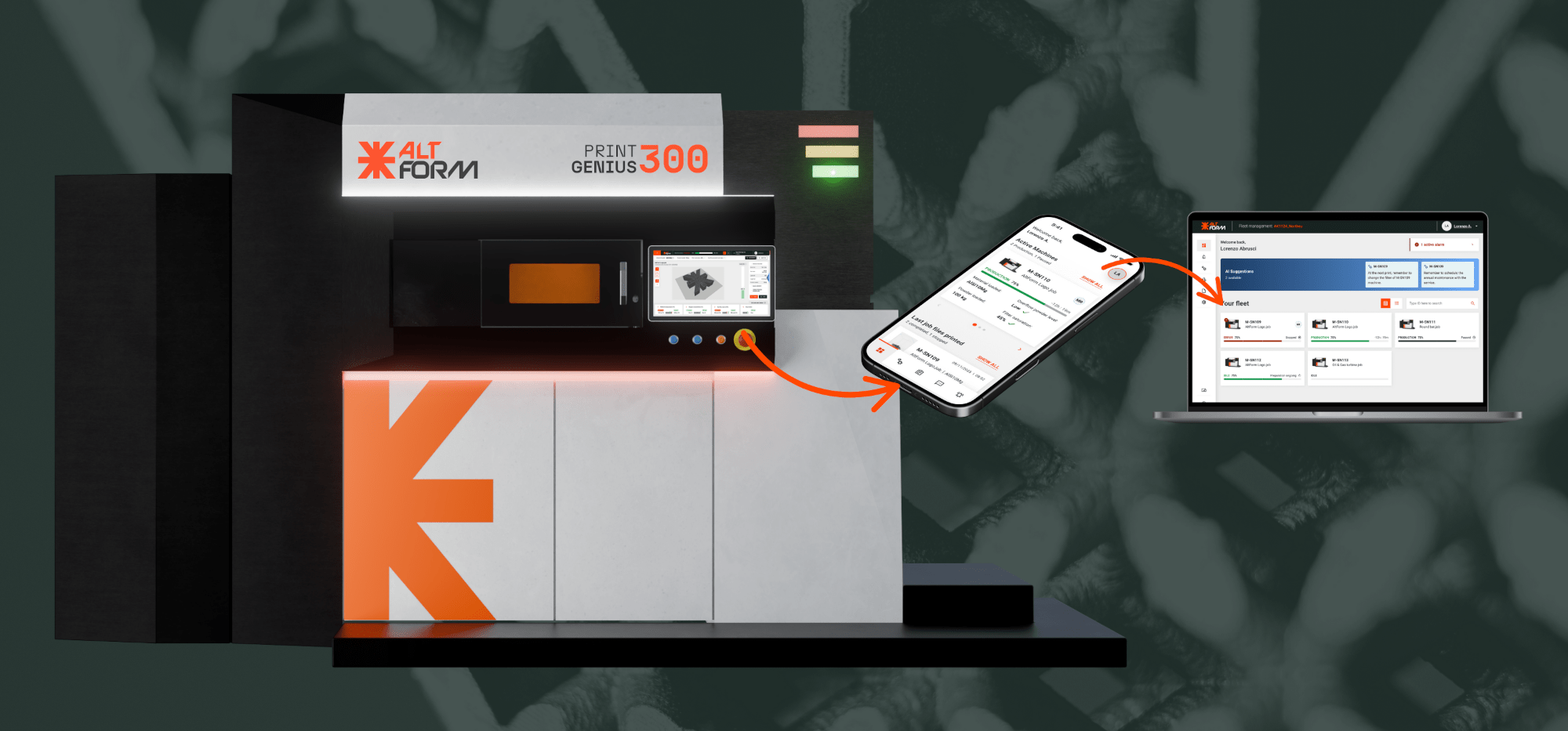
AltForm identified this shift early and positioned software as the primary differentiator rather than an accessory component. The result is an ecosystem structured on three interconnected levels: an integrated HMI, a mobile application for remote monitoring and control, and a centralized fleet management platform.
The AI-powered HMI: a human-centric approach
Traditional PBF systems require highly skilled operators, often engineers rather than technicians. The real cost of this requirement is frequently underestimated: the total cost of ownership of an AM system includes not just capital expenditure and materials, but the ongoing cost of specialized personnel needed to run it day to day. This is one of the most significant barriers to large-scale industrial adoption.
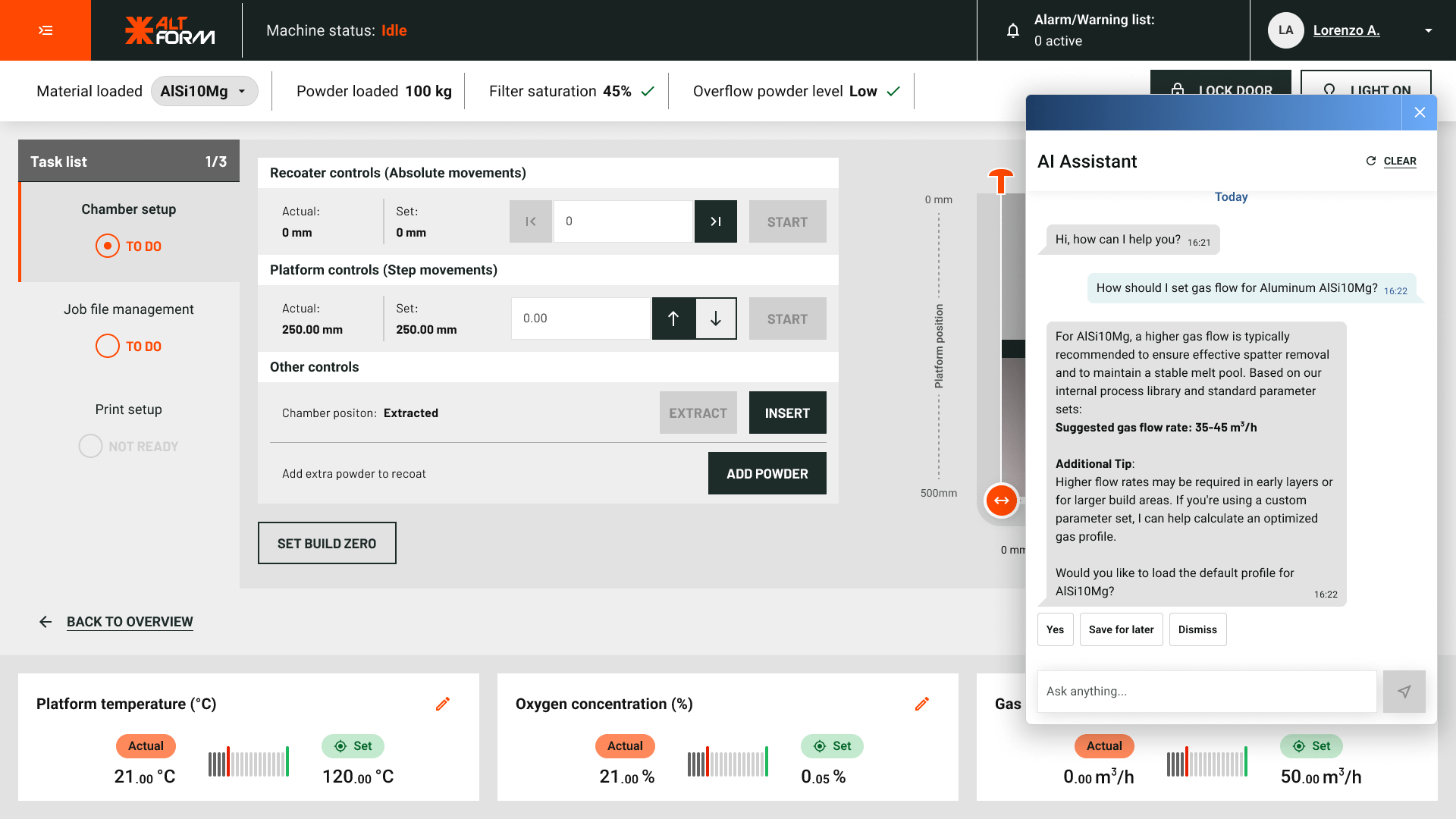
AltForm’s response is an AI-powered Human Machine Interface built around a different principle: rather than positioning artificial intelligence as an opaque optimization engine, the system takes a human-centric approach. The AI assistant is a digital companion that supports the operator step by step through daily tasks, not a system that makes decisions invisibly.
Preparation and job setup
Before each build, the assistant guides the operator through job configuration, parameter selection, and workflow execution. Context-aware recommendations adapt to the specific material, geometry, and machine state, reducing the preparation time and the expertise threshold required to run complex builds.
In-process monitoring and anomaly detection
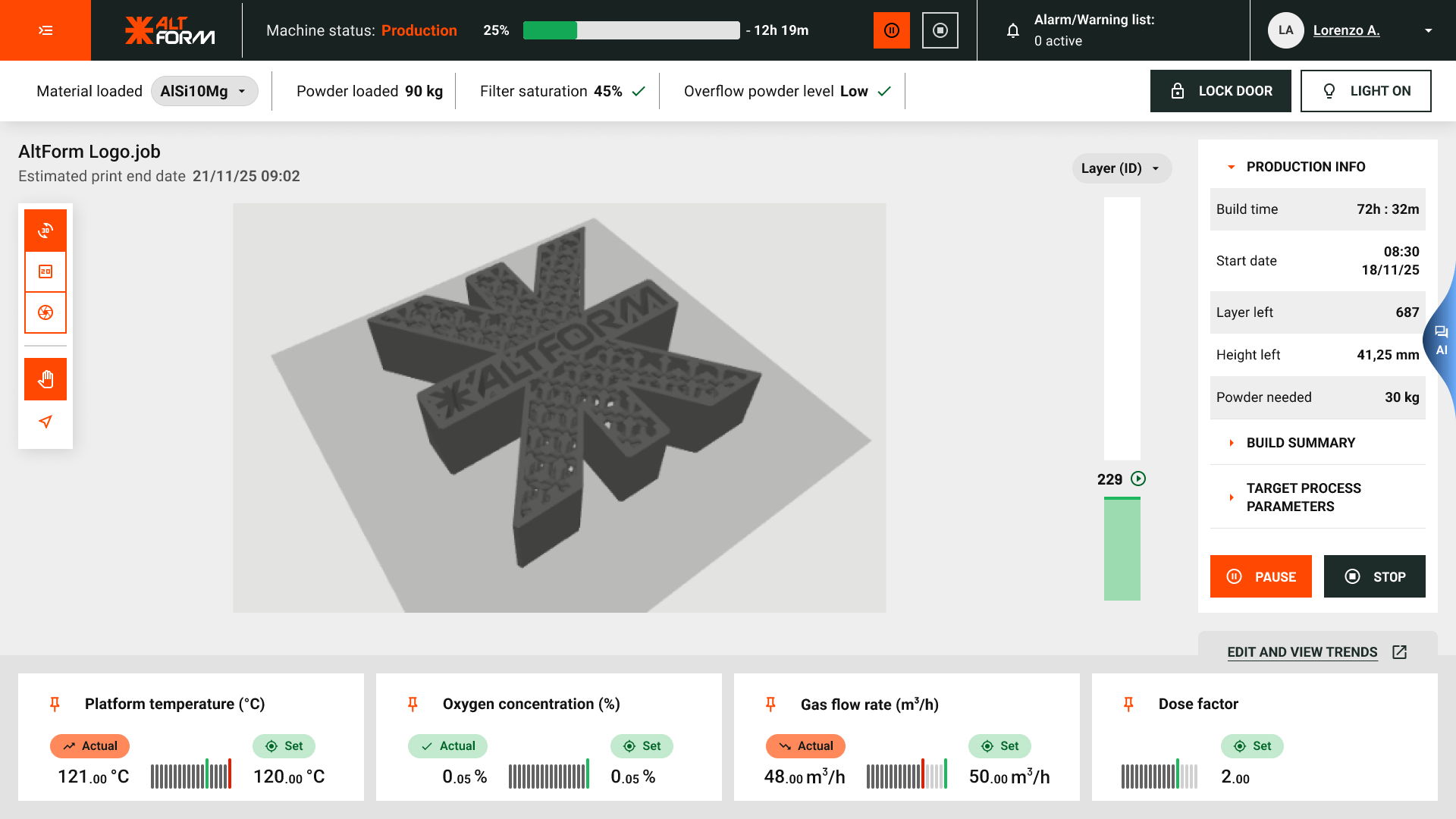
During production, the assistant monitors process stability in real time. When deviations from expected process parameters are detected, the system alerts the operator and proposes corrective actions based on the current machine state and historical build data. Anomalies are surfaced and interpreted before they become defects, reducing scrap, rework, and unplanned downtime.
Maintenance guidance
For scheduled and corrective maintenance procedures, the assistant accompanies operators through each step, reducing dependency on external technical support. Maintenance tasks that previously required specialist intervention can be executed by trained production operators following AI-guided workflows.
Predictive maintenance
By analyzing usage patterns and component wear data over time, the system formulates predictive maintenance recommendations before failures occur. The result is a shift from reactive to preventive maintenance, with measurable impact on machine availability and production continuity.
The aggregate effect of these capabilities is a reduction in operator skill requirements, a compression of onboarding and training time, and a decrease in unplanned downtime. For production environments where shift changes, operator turnover, and multi-site operations are the norm, this is a structural advantage.
Mobile access and remote control
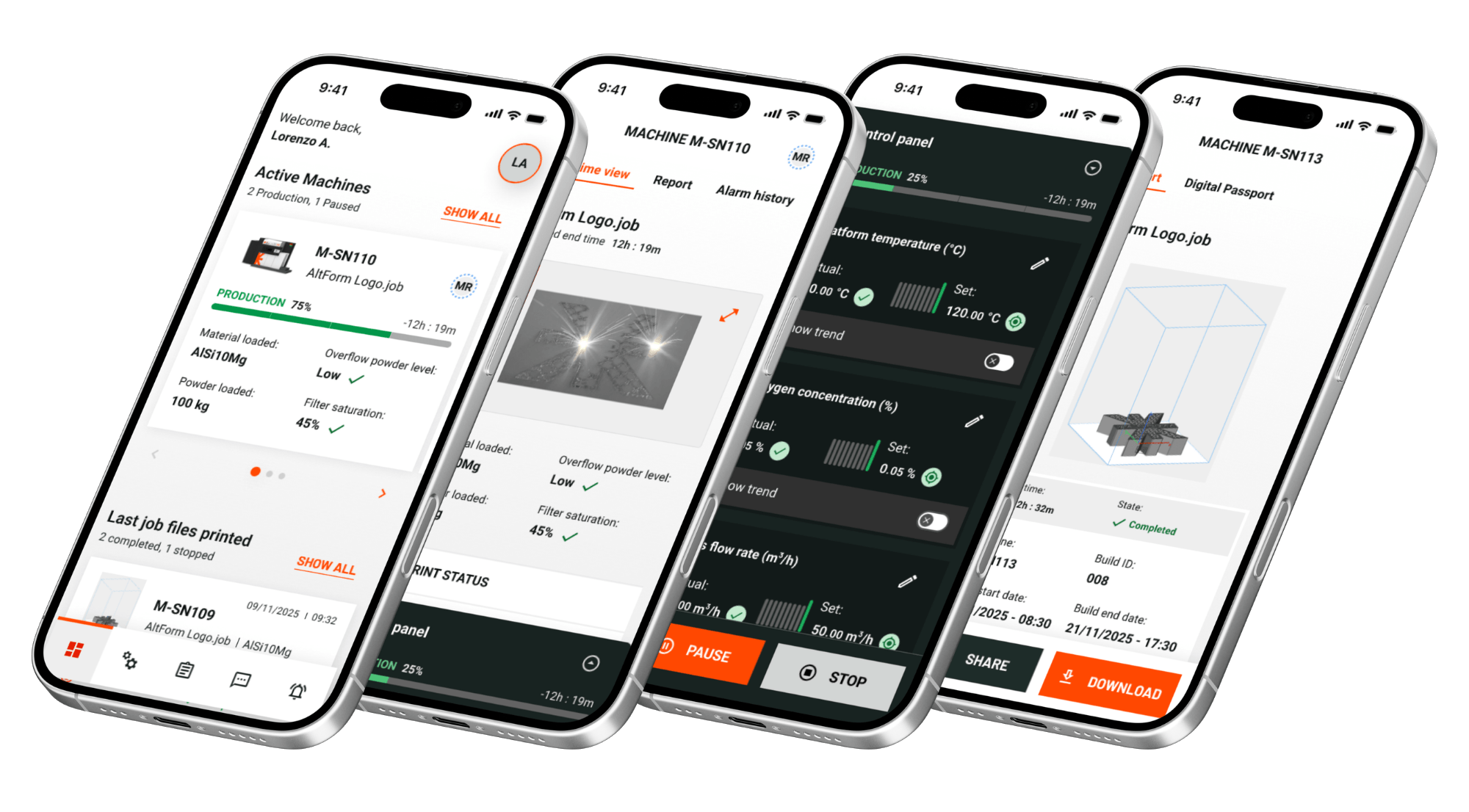
The mobile application extends the same logic beyond the machine. Operators, supervisors, and production managers can access build status, real-time production metrics, and machine alerts from any device, without being physically present on the production floor.
This capability matters in two distinct scenarios. In single-site operations, it allows supervisors to monitor running builds without constant floor presence, freeing bandwidth for higher-value tasks. In multi-site and distributed production environments, it provides visibility across locations from a single interface, without requiring on-site engineering resources at each machine.
Remote monitoring also enables faster response to process anomalies. When an alert is triggered, the responsible operator can assess the situation and decide on corrective action immediately, regardless of the location, reducing the window between anomaly detection and resolution.
Fleet management: from machine to production platform
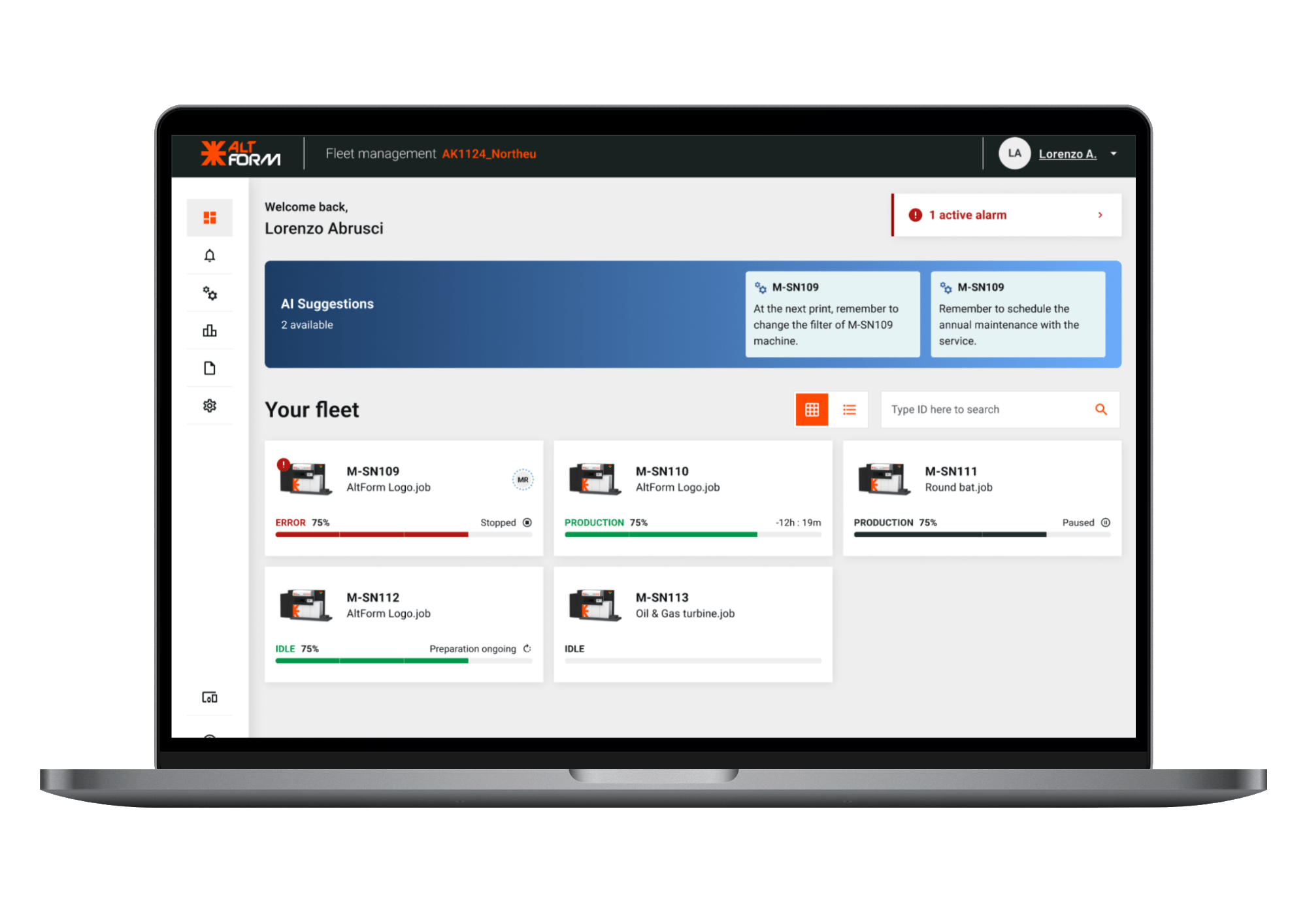
The fleet management platform is where the software ecosystem transitions from a machine-level tool to a production management infrastructure.
A single dashboard provides centralized visibility across multiple PBF systems running in parallel: production scheduling, performance analytics, process data, and traceability across the entire AM production environment. For manufacturers scaling from a single machine to a multi-system production line: the transition that defines true industrialization. This level of visibility is not optional.
The platform supports MES and ERP integration via OPC-UA and Siemens ecosystem connectivity, positioning AltForm systems as components of a connected factory infrastructure rather than isolated production islands. Production data flows upstream into planning and reporting systems; process parameters and job files flow downstream to the machines. The production environment becomes legible, manageable, and optimizable as a whole.
Blockchain traceability: documentation as a competitive asset
In aerospace, medical, and defense applications, part traceability is a certification requirement. In automotive, it is increasingly demanded by supply chain transparency initiatives. In any regulated environment, the ability to prove what was produced, how, and when is a qualification prerequisite.
AltForm’s blockchain integration provides exactly this: an immutable digital passport for each component produced, certifying the design file, the process parameters, the machine used, and the production date. The record cannot be altered after the fact, which is precisely what makes it useful for audit and regulatory compliance.
The same infrastructure enables a second, strategically significant capability: encrypted build files can be transmitted to third-party service bureaus and distributed production partners without exposing the underlying component geometry. The machine executes the build; the design remains protected. For manufacturers working with proprietary geometries in distributed production environments, this is a concrete answer to the IP protection challenge that has historically made outsourced AM production difficult to scale.
The platform in context: Print 300 and Print 400 Series
The software ecosystem described here is integrated across AltForm’s industrial PBF platforms: the Print 300 and Print 400 series.
The Print 300 series, available in single, dual, and quad-laser configurations (Print Sharp, Genius, and Brilliance 300), is designed for mid-size serial production with a build volume of 330×330×450 mm. The Print 400 series scales to 420×420×450 mm (extendable to 1,000 mm on the Z-axis in the XL version), with dual and quad-laser configurations. Both platforms combine modular extractable build chambers, advanced filtration with automatic backflushing, and the full AI software suite in a production-ready architecture.
For research, materials development, and specialized applications, the Print 100 and 200 series offer the same open-parameter architecture in a compact format. The Print Blue 100 extends the portfolio to reflective materials: copper, precious metals, and high-reflectivity alloys, with the market’s only commercially available blue laser PBF system.
What comes next
The current AI assistant represents the first step of a broader roadmap. Near-term development is focused on deeper real-time monitoring with AI-driven pattern recognition, closed-loop process optimization with direct correlation between sensor data and part quality, and expanded predictive models trained on production data across the installed fleet.
The longer-term direction is cross-technology: extending the same software logic to Direct Energy Deposition, remote laser welding, and surface treatment processes. These are less standardized than PBF, more deeply integrated with traditional machine tool infrastructure, and precisely the contexts where intelligent orchestration delivers the greatest operational value.
The strategic direction is clear: integrating advanced laser processes, automation, and artificial intelligence into unified industrial solutions. Not to replace human expertise, but to amplify it, making complex manufacturing technologies more accessible, more repeatable, and more scalable across any production context.